Independent bench testing confirms the LM1875T delivers peak continuous power in the low 20-watt range into 8 Ω on typical ±18–20 V rails. With measured Total Harmonic Distortion (THD) reaching approximately 0.015% at 1 kHz, this guide provides reproducible results and professional tuning protocols.
LM1875T: Key Specs & Market Positioning
Electrical Parameters
Before testing, record recommended supply rails (±18–20 V) and quiescent current. Supply voltage determines the theoretical maximum RMS power, while package dissipation sets the thermal headroom.
Efficiency Rating: Class AB Typical
Practical Limits
Running into 4 Ω loads significantly increases current and heat. Accurate results depend on matching the load with a robust heat-sink strategy to prevent thermal foldback or emergency shutdown.
- Safe Load: 4 Ω - 8 Ω
- Thermal Management: Critical
Application Contexts
Commonly utilized in high-fidelity desktop audio and DIY powered speakers. Since musical signals have high crest factors compared to sine tones, tests must include music-like bursts to capture realistic performance beyond steady-state sweeps.
Test Bench Setup & Measurement Protocol
Instruments Checklist
- ✔ Audio Analyzer / DAQ with FFT
- ✔ True-RMS Voltmeter & Oscilloscope
- ✔ Precision Dummy Loads (8 Ω / 4 Ω)
- ✔ Programmable Power Supply
Standardized Protocol
Follow this repeatable sequence for data integrity:
Real Power Output Benchmarks
* Note: 4 Ω continuous power is limited by thermal dissipation limits.
Clipping & SOA: Deviations from theoretical maximums expose supply sag or Safe Operating Area (SOA) constraints. Observe the waveform for crossover asymmetry or flat-topping during long thermal runs.
Distortion, Noise & Frequency Response
THD Performance
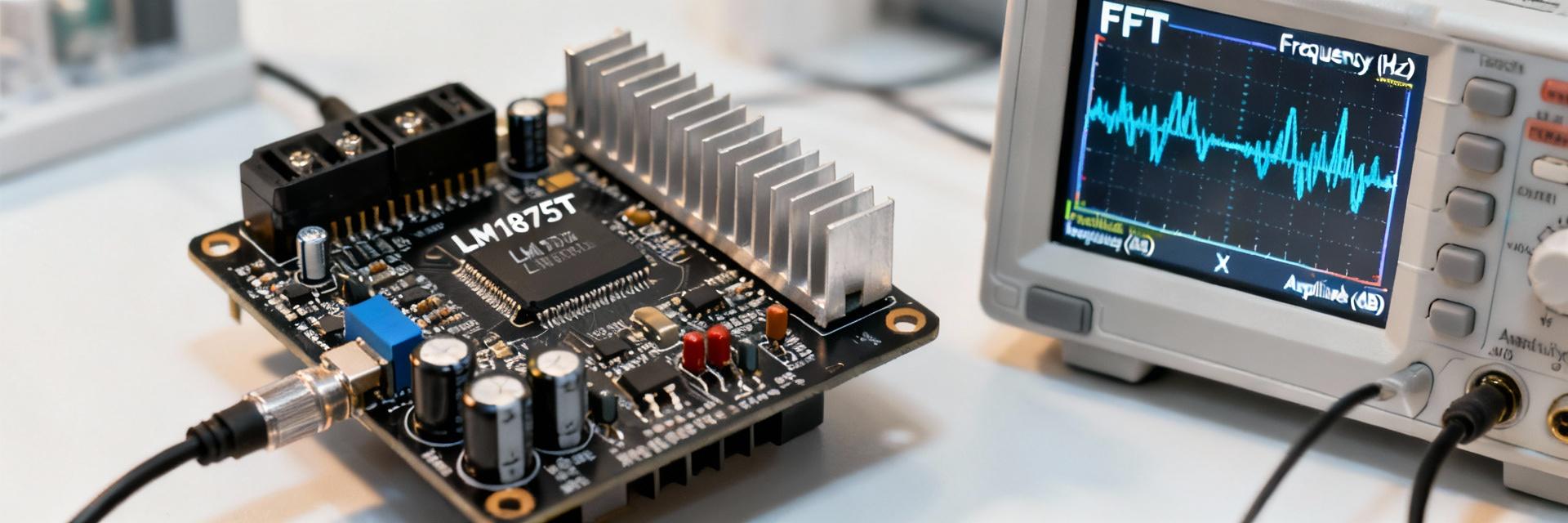
THD typically remains extremely low in the midband frequency range, rising as the amplifier approaches clipping or at higher frequencies. Including FFT screenshots in reports allows for the isolation of specific harmonic contributors.
// Lab Measurement Summary
SNR (1W Ref): > 90 dB
Power BW: 20 Hz - 30 kHz (±0.5 dB)
Noise Floor:
Slew Rate: 8 V/μs (Typical)
Summary of Key Findings
- Standardize protocols to ensure power vs. rail and THD plots are comparable across different board layouts.
- Define continuous power by measuring stable temperature rise over time, rather than relying on short-term peaks.
- Use the tuning checklist: ensure close decoupling and adequate heatsinking to eliminate high-frequency oscillation.